
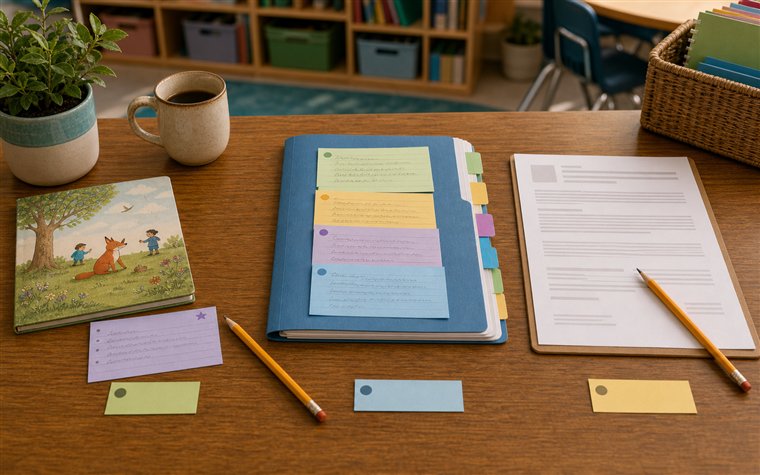
Step 1: Save the moment while it is still clear
The quick note flow is built for the part of the day when a student says or does something worth keeping and the class is already moving on. The faster the note is saved, the less likely it turns into a memory task later.
The note does not need to be long. It needs enough detail to survive the week:
- Student.
- Task or setting.
- What happened.
- Support or independence.
- Why it may matter later.
NAEYC's practical note-taking guidance is useful because it starts from real teaching conditions. Teachers need note routines that are quick enough for the classroom, not forms that only work after school.
In Dodl Notes, the quick note should capture the classroom evidence before the transition, dismissal, or next group erases the details. Save the observation to the right class and student. Do not try to write the final report comment yet.
Step 2: Keep the note attached to the right history
Teachers do not need a pile of isolated notes. They need class and student history that can be reopened before a conference, support meeting, or report-card deadline.
That is why the note should carry context. "Asked for help" is too thin. "During independent writing, asked for help choosing a second reason after using the sentence starter for the first reason" is still short, but it gives you the task and instructional detail.
Head Start guidance on objective observation notes separates what happened from the adult's interpretation. That makes the note more useful later. Save the observed action first. Add the meaning only after the evidence is clear.
Dodl Notes supports that by keeping the note in the student thread. The thread matters because one note rarely tells the whole story. A report comment usually needs a pattern, a contrast, or a current example.
Step 3: Review the note before writing week
Capturing the note is the easy part. Retrieval is what makes the workflow pay off.
Once a week, open Notes Explorer and choose a few student histories. Look for notes that could support a report comment:
- A clear strength.
- A current next step.
- A support that helped.
- A growth example.
- A pattern across more than one day.
Reading Rockets describes informal classroom assessment as evidence teachers can use to identify strengths and needs. A quick note becomes valuable when it helps with that kind of instructional judgment.
If a note is too vague, adjust your next observation. Maybe you need the task. Maybe you need the support. Maybe you need a second example before saying it is a pattern.
Step 4: Use dashboard coverage to find thin records
Before report-card week, the dashboard can help identify where the record is uneven. A student may have several notes, but all of them may be about behavior. Another student may have a strong reading note and no current math evidence. Another may not appear recently at all.
The What Works Clearinghouse guide on using student data emphasizes using evidence to answer focused questions and plan action. The dashboard should prompt that kind of question:
- Who needs a stronger academic example?
- Which notes need a next step?
- Which students have only old evidence?
- Which support has been tried more than once?
The answer should shape the next few classroom notes. You are collecting evidence to make the future report comment more accurate, not for its own sake.
Step 5: Turn evidence into report language
When writing week arrives, reopen the student history before drafting. Choose one note that gives you the evidence and one sentence that gives you the meaning.
Example note:
"During small-group reading, Nia reread the sentence after miscued word, checked the beginning sound, and corrected it without a prompt."
Report language:
"Nia is using rereading and beginning-sound checks more independently during small-group reading."
The second sentence is more polished, but it depends on the first. If the original note only said "improving in reading," the report comment would be harder to trust.
Dodl Notes helps because the evidence and report workflow are close together. You can move from student history to drafting without rebuilding the story from separate files.
Step 6: Save the reporting insight back into the student history
Report writing often reveals what you still do not know. If a comment feels thin, save that as a next observation target. If you notice a strong pattern, save the summary back into the student history so it is available for conferences or future planning.
The loop becomes:
- Capture a quick classroom note.
- Keep it attached to student history.
- Review coverage before writing.
- Draft from evidence.
- Save the next observation need.
That loop is the product story. Dodl Notes makes the small note easier to recover at the moment the teacher needs it, without asking anyone to write more for the sake of it.
Step 7: Use weak drafts as observation prompts
Sometimes the report draft still feels thin even after you review the student history. Treat that as useful information. A weak draft usually points to a missing observation, not a writing failure.
If the sentence says "continues to develop confidence," ask what confidence would look like in class. If it says "needs support with problem solving," ask which task, strategy, or prompt would make that clear. If it says "participates more," ask for the setting and comparison point.
Turn the weak draft into a next note target:
- Watch for one independent strategy.
- Save one example after feedback.
- Capture one support that changed the task.
- Find one current growth comparison.
That keeps the workflow moving after reports too. The next quick note becomes better because the writing process showed what evidence was missing.
Keep the report sentence tied to the original context
A report sentence can become too polished if it drifts away from the original classroom moment. Keep the quick note close while drafting. The note should answer what the student did, what support was present, and what changed afterward.
Original note:
"During writing, reread the first paragraph after I pointed to the checklist, then added one detail about the setting."
Report sentence:
"She is beginning to use revision checklists to add more specific details to her writing."
The report sentence sounds cleaner, but it still depends on the note. If the checklist was important, keep that support in the comment. If the student added the detail independently later, update the language. This protects report comments from becoming vague praise or broad concern.
In a report workflow, the quick note is the evidence anchor that keeps the final wording honest, not the final wording itself.