
Start with the comment you will need to write
Before report-card week, choose one student and draft the comment in your head. If the sentence sounds like "works hard" or "is making progress," pause. Those phrases are not wrong, but they usually need evidence beside them.
A better tracking question is practical: what would make that comment believable to a family, useful for the next teacher, and fair to the student?
The What Works Clearinghouse practice guide on using student achievement data recommends using data to ask focused instructional questions and plan next steps. For classroom notes, that means tracking evidence that can answer a later reporting question, not saving every moment that happened.
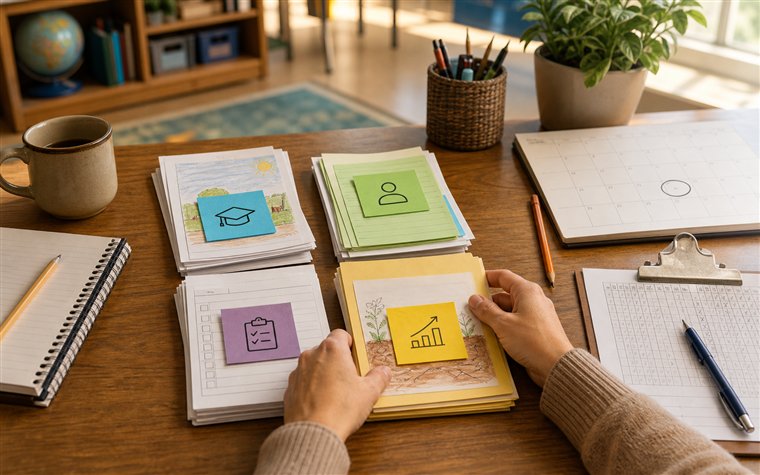
Use four buckets for a simple report-card evidence set:
- Academic evidence: skill, strategy, accuracy, fluency, explanation, revision.
- Learning behavior: independence, persistence, collaboration, organization, response to feedback.
- Support pattern: prompt, scaffold, small-group help, tool, seating, reteaching, check-in.
- Growth example: what changed from earlier in the term.
Those buckets are broad enough to fit reading, writing, math, and learning skills. They are also narrow enough to review quickly in Notes Explorer.
Track context, not just performance
A report comment is easier to write when the note includes the setting. "Used a number line" is helpful, but "used a number line during two-digit subtraction after the first regrouping example" is more useful. The second note tells you what the student was doing, when the strategy appeared, and what support was nearby.
Reading Rockets describes informal classroom-based assessment as a way to identify strengths and needs during regular instruction. That same idea helps report prep. A note should not only record whether the student succeeded. It should preserve enough lesson context to explain the evidence later.
Try this quick shape:
- Student action: what the student did or said.
- Task: what the class was working on.
- Support: what help, tool, prompt, or independence was visible.
- Meaning: why this might matter for reporting.
That format keeps the note short while protecting it from becoming a label.
Look for spread before you look for polish
Report-card stress often comes from uneven evidence. One student has six reading notes and no math evidence. Another has behavior notes but no academic examples. A third has only the moment that went badly.
Aim for enough spread that your final comment does not depend on one memory, rather than equal documentation for every student in every category. A short weekly review can be small:
- Open the class history.
- Choose three to five students.
- Check whether each student has at least one academic note and one learning-behavior note.
- Mark who needs a better example next week.
Dodl Notes helps here because the dashboard can show where coverage is thin before you start writing. Notes Explorer then gives the actual student thread when a count is not enough.
Keep observations objective enough to reuse
The report-card version of a vague note is often a vague comment. "Distracted during writing" might be true, but it gives you little to work with later. "During independent writing, looked at the anchor chart twice, wrote one sentence, then asked for help starting the next idea" is more useful.
Head Start guidance on objective observation notes separates what was seen and heard from the meaning adults add later. That distinction matters before report cards because comments should be based on classroom evidence, not a rushed impression from the final week.
When you write the note, keep the observation first and the interpretation second:
- Observation: "Used the word wall to check three sight words during journal writing."
- Possible reporting meaning: "Uses classroom tools more independently during writing."
The second sentence may become part of a report comment. The first sentence keeps it grounded.
Save one growth comparison before writing starts
Families usually want to know what changed. A strong report comment often compares the student's current work to an earlier pattern: more independence, better strategy use, stronger stamina, clearer explanation, or more consistent participation.
NAEYC's note-taking guidance emphasizes practical observation strategies that fit inside real teaching. For report prep, the most useful strategy is saving one earlier note and one current note that show movement.
You do not need a long portfolio for every student. Pick one class period this week and watch for growth evidence:
- A student rereads without being prompted.
- A student explains a math strategy to a partner.
- A student starts the second sentence faster than last month.
- A student accepts feedback and revises one detail.
Save the note while the moment is still specific. Add the class, student, and task. During report-card prep, reopen the student history and look for the contrast between earlier evidence and current evidence.
Use a report-prep checklist that stays small
Before the next writing week, check each student for five pieces of evidence:
- One current academic strength.
- One next instructional step.
- One learning behavior example.
- One support or independence pattern.
- One growth comparison.
If you cannot find all five, do not panic. Choose the missing piece that would make the report comment clearer and watch for that next. A useful tracking system should tell you what to observe next, not just make you feel behind.
Report-card prep gets easier when the evidence already has a home. Save the classroom moment, keep the context attached, and review coverage before the comment box is open. That is the difference between writing from memory and writing from a usable student history.