
Walk into the meeting with evidence, not a script
Conference prep gets weaker when it starts with broad labels. "He is bright but distracted" may be familiar teacher language, but it can leave a family unsure what the student actually did, what helped, and what should happen next.
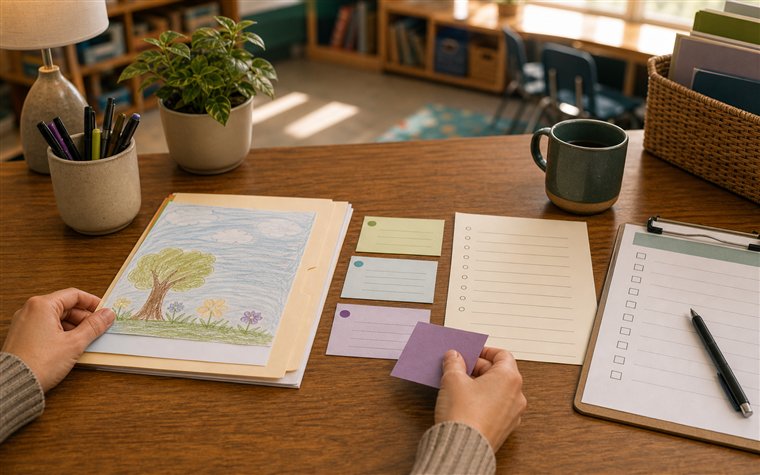
Start with two saved classroom moments. One should show a strength. One should show a next step. If you can explain both in plain language, you have enough to begin the meeting.
The What Works Clearinghouse data-use practice guide frames evidence as a way to ask better instructional questions and plan next actions. A conference record can work the same way. It should help the teacher and family understand the student's current pattern, not simply document that a meeting occurred.
Before the meeting, open Notes Explorer and scan the student history for:
- A recent academic example.
- A learning behavior example.
- A support that helped.
- A question you want to ask the family.
- One next step that fits school and home.
That is a small prep routine, but it keeps the conversation connected to real classroom evidence.
Separate what happened from what you think it means
Conference notes can become emotionally loaded if the observation is not clear. "Avoids writing" sounds final. "Started the writing task after I reread the prompt and helped choose the first sentence" gives everyone more room to plan.
Head Start guidance on objective observation notes is useful beyond early childhood settings because it keeps observation and interpretation in the right order. First record what was seen or heard. Then add what it might mean.
Use that order during conference prep:
- Classroom moment: what the student did or said.
- Setting: lesson, task, group, or transition.
- Support: prompt, tool, partner, reteaching, or independence.
- Meaning: the pattern you want to discuss.
If a note skips the first three pieces, it may not be ready for a family conversation. It may still be a feeling you need to check.
Bring student work into the record
Families often understand a classroom pattern faster when it is tied to a visible work sample or task. A writing page, math explanation, reading response, or project note can anchor the conversation.
The National PTA family-school partnership standards emphasize shared responsibility and two-way communication between families and schools. For documentation, that means the conference note should leave room for family context, not just teacher reporting.
Try a three-part conference note:
- Evidence I shared: the classroom example or work sample.
- Family context: what the family added, clarified, or asked.
- Next step: what the teacher, student, or family will try next.
Dodl Notes can hold the classroom note before the meeting and the follow-up note after it. That matters because the family context should not live on a separate sticky note that disappears before the next support conversation.
Keep the follow-up note short and useful
After the meeting, write the follow-up while the details are still fresh. Do not try to recreate the whole conversation. Capture the parts that will matter later:
- Date and reason for the meeting.
- Main strength discussed.
- Main concern or question.
- Agreed support.
- When you will check back.
California State PTA's parent-teacher conference guidance encourages families to discuss progress, ask questions, and plan follow-up. A teacher-facing conference note should preserve the same practical outcome: what everyone agreed to try.
The follow-up note should be easy to find before the next report, support meeting, or email. In Dodl Notes, save it to the same student history as the classroom examples. Later, you can reopen the thread and see both the evidence and the plan.
Avoid turning conference documentation into a second paperwork system
A new teacher can overbuild conference documentation quickly: one sheet for prep, one form for the meeting, one tracker for follow-up, one spreadsheet for who attended. That may look organized, but it creates too many places to look later.
Choose one durable record for the student. Keep the prep notes, meeting summary, and next steps together. If your school requires a separate form, complete it, but still save the useful instructional details where you can find them again.
A simple conference documentation routine can be:
- Review student history.
- Choose two classroom examples.
- Add family questions before the meeting.
- Save the follow-up note after the meeting.
- Reopen the note within two weeks and check whether the next step happened.
That last step is easy to skip. It is also what makes documentation meaningful. A conference record should not end with "meeting held." It should help the teacher remember the agreed support and watch whether it changed the student's classroom experience.
Prepare one example for each claim
Conference notes are strongest when every claim has one classroom example behind it. If the teacher plans to say a student is becoming more independent, the note should show the moment: started after reading the direction card, chose the next math problem without a prompt, or reread the draft before asking for help.
Use the same rule for concerns. Instead of preparing "needs to focus," prepare the task, the observed action, the support tried, and what changed. That gives families something concrete to understand and gives the teacher a next step to discuss.
One example does not prove a pattern by itself, but it keeps the conversation grounded. When several notes point in the same direction, the teacher can speak with more care and confidence. The conference becomes a review of evidence, not a performance from memory.