
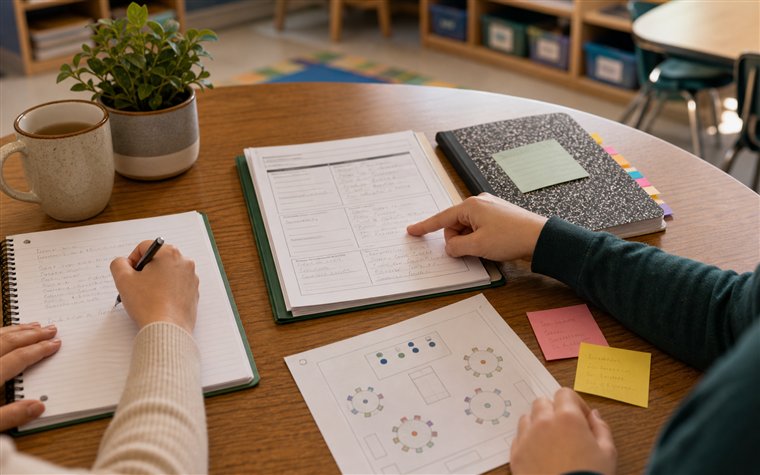
Choose the placement slice you can actually observe
Student teaching creates too much information to track all at once. You may be watching classroom routines, lesson pacing, individual students, mentor language, assessment, behavior support, and your own instructional moves in the same hour.
Start smaller. Pick one class, one small group, or one instructional block. Save notes from that slice for a week. The goal is to build a useful feedback trail, not a complete record of the whole placement.
NAEYC's practical note-taking guidance is written for busy teachers, but the same principle helps teacher candidates: notes should fit inside real classroom life. A practicum note that takes ten minutes to format will not survive a full teaching day.
Use a short shape:
- Student or group.
- Task or lesson moment.
- What happened.
- What I tried.
- Question for mentor feedback.
That last line matters. Student teaching notes do more than feed future report cards. They are also evidence for reflection, lesson adjustment, and mentor conversation.
Keep observation and reflection in separate sentences
Teacher candidates are often asked to reflect, but reflection gets stronger when the observation underneath it is clear. "The group did not understand the lesson" is a reflection. "Four students sorted the first two examples correctly, then stopped when the problem changed format" is an observation.
Head Start guidance on objective observation notes separates what adults see and hear from what they infer. During practicum, that habit protects your reflection from becoming too general.
Try writing two sentences:
- Observation: "During the math partner task, three students used counters for the first problem and waited after the second prompt."
- Reflection: "I need to check whether my directions changed too quickly after the model."
The mentor can respond to that. They can talk about directions, modeling, timing, or student readiness. A broad note like "lesson was confusing" gives them less to work with.
Bring evidence into mentor meetings
Mentor meetings often drift toward how the lesson felt. Feelings are useful, but they need evidence beside them. Before the meeting, open your notes and choose two examples:
- One moment that shows a student learning or participating.
- One moment where your instruction needs feedback.
The What Works Clearinghouse guide on using data for instructional decisions is not a student-teaching handbook, but its logic applies: evidence is useful when it helps educators ask a focused question and plan a next step.
In Dodl Notes, save the classroom observation first. Before the mentor conversation, reopen the student or group history in Notes Explorer and add the question you want to ask. After the conversation, save the mentor's next step in the same record.
That creates a thread:
- Classroom moment.
- Candidate reflection.
- Mentor feedback.
- Next attempt.
When placement moves quickly, that thread is more valuable than scattered notes in a notebook margin.
Track your instructional moves, not only student responses
Student notes can help you see students more clearly, but during practicum they should also help you see your own teaching choices. Record the support you used:
- Prompted with a question.
- Modeled one example again.
- Changed partners.
- Added a visual.
- Reduced the task.
- Waited longer before stepping in.
Then record how students responded. Did the support help one student, the whole group, or no one? Did it create a new question?
Some university programs use formative observation and feedback forms during student teaching. The University of Delaware student teaching formative forms page is one example of how clinical practice often connects observation, feedback, and next steps. Your personal note workflow should support that same cycle even if your local forms look different.
Use Friday review to prepare for the next teaching week
At the end of the week, do a ten-minute review. Do not reread every note. Look for three patterns:
- Students: who appears often, and who is missing?
- Instruction: what support did you use repeatedly?
- Feedback: what mentor question keeps coming back?
If one student only appears in behavior notes, watch for an academic strength next week. If one group appears in every confusion note, ask your mentor to help you plan the next scaffold. If your notes are mostly about pacing, choose one lesson segment to rehearse.
A student teaching note workflow should make the next week more focused. It does not need to impress anyone. It needs to help you remember the evidence, ask better mentor questions, and try one better move the next time you teach.
Make mentor feedback easier to use
Student teachers often receive feedback in many forms: a hallway comment, a written observation, a quick suggestion before the next lesson, or a formal evaluation note. A useful workflow keeps those comments connected to classroom evidence.
After a mentor conversation, save one note that names the teaching move and the next attempt. For example: "Mentor suggested wait time after math questions. In the next small group, count silently before rephrasing." That note is more useful than "work on questioning" because it names the specific move to practice.
After the next lesson, add a follow-up note. Did the move change student responses? Did the teacher candidate remember it only once? Did it help in one subject but not another? Those short notes create a reflection trail that can support practicum meetings and portfolio writing.
The workflow should help a student teacher show growth through evidence, not only through a final reflection written from memory.