
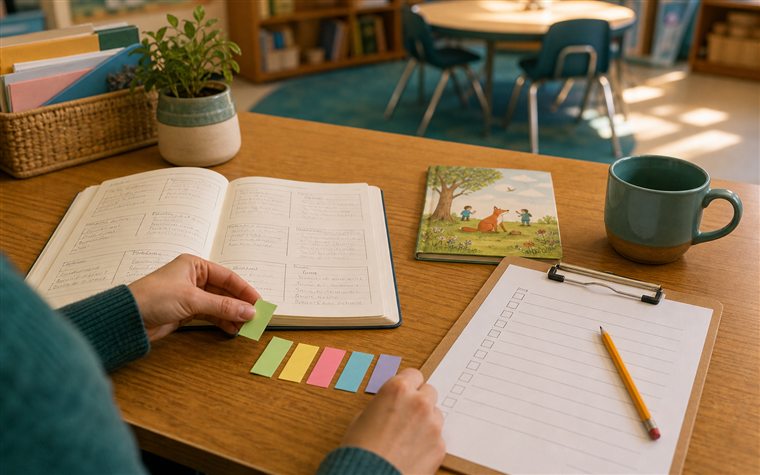
What counts as an anecdotal note worth saving
An anecdotal note is a short record of something a student did or said in a real classroom setting, not a journal entry. For a first-year teacher, the useful standard is simple: would this note help you plan the next lesson, explain a pattern to a mentor, or remember the student more accurately later?
NAEYC guidance on practical note strategies frames observation-based assessment as part of regular teaching, not a separate paperwork project. The strongest notes describe a concrete action, name the learning context, and give enough detail to support a teaching decision.
Instead of saving "Mark was focused during reading," write what you could still use next week: "During independent reading, Mark reread the paragraph twice, checked the sentence before it, and explained the unfamiliar word to his partner."
That second note is longer, but it is also more usable. It gives you the student action, the task, and the reason the moment mattered. A quick note can be brief without becoming vague.
Keep the note objective before you interpret it
New teachers often mix observation and interpretation because the class is moving fast. You see a student put their head down and write "refused to work." You see a student talk during partner reading and write "off task." Those labels might feel efficient, but they are hard to use later because another adult cannot tell what actually happened.
Head Start guidance on objective observation notes makes the same distinction: record what you see and hear before adding meaning. For classroom notes, that means writing the action first.
Use this order when the moment is fresh:
- Name the setting: reading group, math center, writing conference, recess, arrival.
- Record the action or words: what the student did, tried, said, avoided, asked, or repeated.
- Add the instructional meaning only if it is clear: possible next step, support used, strength noticed, or question to revisit.
For example: "During partner reading, Jordan skipped two multisyllable words, paused, then asked to reread the page with me. Next reading group: check decoding strategy before fluency work."
The final sentence is your interpretation. It works because the note first gives the observable classroom moment.
Do not try to document everyone every day
The fastest way to abandon anecdotal notes is to make the system too ambitious. In the first month of teaching, you are still learning routines, names, transitions, curriculum pacing, and classroom management. A note habit has to survive that load.
NAEYC suggests being selective about what you observe and using a manageable focus group approach instead of trying to document everything for every child. For a new teacher, that can be even smaller: pick one class, choose five students for the week, and save one useful note per day.
The point is coverage over time, not perfection on day one. A focused routine also protects the quality of the notes. You are more likely to write a concrete observation if you know which students you are watching before the lesson begins.
A starter week can look like this:
- Monday: two reading-group observations
- Tuesday: one math strategy note
- Wednesday: one social or collaboration note
- Thursday: one writing conference note
- Friday: open the notes and decide which ones still help
The Friday review is important. If a note is too vague to help after four days, adjust the format before collecting more of the same.
Use informal notes to guide instruction
Informal assessment is useful because it happens close to the learning. Reading Rockets explains informal classroom assessment as a way to identify student strengths and needs, then guide next instructional steps. Anecdotal notes are one practical form of that work.
For a first-year teacher, the goal is to make one teaching decision easier, not to create a record for its own sake. That decision might be small:
- Which student needs a quick conference tomorrow?
- Who used a strategy independently?
- Which misconception appeared in more than one math group?
- What example should you bring to a mentor meeting?
- Which strength should you mention during a family conversation?
If the note does not help with a decision like that, it may not need to be saved. This is where Dodl Notes can stay light: save the quick note, tag the class and student, then use Notes Explorer to see whether a pattern is forming before report prep begins.
When a behavior note needs more context
Some classroom moments need more than a short "what happened" line. If a student behavior repeats, the surrounding context matters. The IRIS Center describes ABC data as a way to look at antecedent, behavior, and consequence so adults can understand the circumstances around a behavior.
Most daily anecdotal notes do not need that full structure. Still, the idea is useful. If a behavior note might affect support planning, write enough context to avoid a misleading record.
Thin note: "Eli disrupted math again."
Better note: "During independent math after the mini lesson, Eli sharpened his pencil three times, talked to the table group, and completed one of six problems. When I moved beside the table and read the first problem aloud, he started the second problem."
Rather than diagnosing the student, the better version shows the task, the action, and the support that changed what happened.
A first-year routine that can last
Start smaller than your instinct tells you. A useful first system has three rules: one focus group for the week, one note format, and one review time.
Use this note shape:
- Student
- Setting
- What I saw or heard
- Why I might need this later
That last line is the filter. It keeps you from saving every classroom event and helps you notice which notes connect to planning, reports, conferences, or support conversations.
At the end of the week, open the student history and read the notes as if you were preparing to talk to a colleague. Keep the notes that still make sense. Rewrite your next notes to be more concrete. Delete or ignore the ones that only captured noise.
First-year teachers do not need a perfect documentation system. They need a repeatable way to notice important student moments, keep them objective, and find them again when the week gets crowded.