
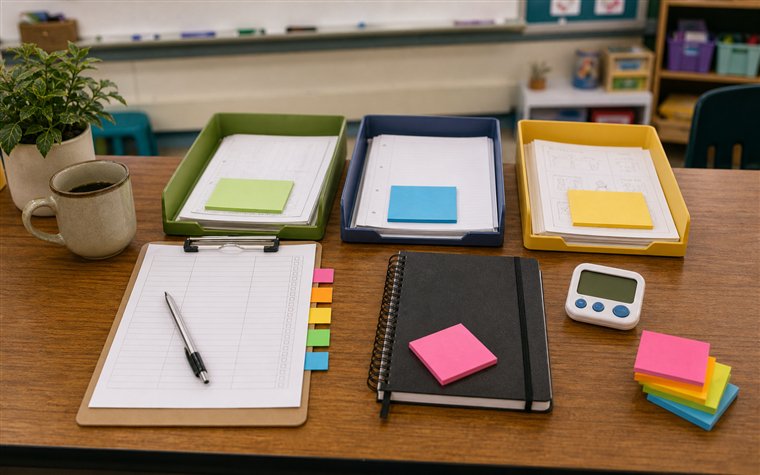
Start by deciding where student evidence lives
A first-year teacher organization system does not need to look impressive. It needs one dependable answer to a boring question: where do I go when I need this student's history back?
If the answer changes by subject, day, or stress level, the system is still too fragile. A binder for reading, a spreadsheet for behavior, a doc for conferences, and sticky notes on the desk may all make sense separately. Together, they make retrieval harder.
The first decision is where classroom evidence will live after the day gets busy, not which template looks best.
NAEYC's practical note-taking guidance treats observation notes as part of teaching, not a separate paperwork event. That is the right standard for a first-year system. If the routine cannot fit between instruction, transitions, emails, and planning, it will not last.
Start with one class and one note home. In Dodl Notes, that can mean a quick note saved to the right class and student, then reviewed later in Notes Explorer.
Build a weekly loop, not a perfect archive
New teachers often try to design the whole school year in September. The better move is to design one week.
Use this loop:
- Capture one useful note during or right after instruction.
- Tag it to the class and student.
- Review student history at the end of the week.
- Choose who needs better evidence next week.
That is the organization system. Everything else should support the loop.
The What Works Clearinghouse data-use practice guide encourages educators to use evidence to ask focused questions and plan instructional action. Your weekly review should do the same. Do not review notes only to admire the stack. Review them to decide what to observe, teach, or follow up on next.
Ask three questions on Friday:
- Who has thin coverage?
- Which notes are too vague to use later?
- What pattern should I watch next week?
Those questions keep the system active.
Keep categories fewer than your instinct wants
A first-year system can collapse under too many labels. If every note needs eight choices before it can be saved, you will stop saving notes during real teaching.
Use a small category set:
- Academic evidence.
- Learning behavior.
- Support or intervention.
- Conference or family follow-up.
- Report-card example.
That is enough to retrieve most notes later. You can always add detail inside the note itself.
Reading Rockets describes informal classroom assessment as everyday evidence that helps teachers identify strengths, needs, and next steps. The category should support that instructional use. It should not become the main task.
If you need to choose between a perfect category and a concrete note, save the concrete note.
Use objective notes as the default
Organization is about where things go, and also about whether the note is usable when you find it.
"Liam struggled in math" is easy to file but hard to reuse. "During independent practice, Liam solved the first regrouping problem with base-ten blocks, then waited after the second problem until I asked him to draw the tens" gives you something to teach from.
Head Start guidance on objective observation notes is a good check here: record what you saw and heard before adding interpretation. A first-year system should make that easier, not harder.
Use a default note shape:
- During...
- The student...
- The support was...
- Next I might...
That sentence frame keeps the note short and specific.
Make report prep part of the system from the beginning
Report-card week should not be the first time you test the system. During each Friday review, choose one note that could support a report comment. If you cannot find one, the system is telling you what to collect next.
Dodl Notes is helpful when the loop stays simple:
- Quick note handles capture.
- Dashboard coverage helps you notice gaps.
- Notes Explorer brings back the student thread.
On its own, the tool is just storage. The system is the habit of saving an observation and reviewing it before the week gets away from you.
Keep the system small enough to restart
Every first-year teacher loses the routine sometimes. A field trip week, illness, assessments, or a difficult classroom stretch can interrupt the system. That does not mean the system failed.
Design it so you can restart in ten minutes:
- Open one class.
- Pick three students.
- Save one current note for each.
- Review those notes on Friday.
A restartable system is better than an impressive one that only works during calm weeks. Your organization should reduce memory work, not add shame. If you can find the student history when you need it, choose the next observation, and keep the loop moving, the system is doing its job.
Build one weekly reset before adding more categories
A first-year system should have a reset point. Without one, notes pile up and the teacher ends up managing the system instead of using it. Pick one weekly review time and keep the question small: which notes will help me teach next week?
During the review, move through one class or one focus group. Look for notes that name a student action, a support, and a next check. If a note only says "good effort" or "struggled with math," leave it behind and make the next note more specific. The review is where the system improves.
Do not add more categories until the reset habit works. A simple routine with five useful notes is better than a detailed structure that never gets reviewed. The system should make Friday planning easier, not create another unfinished teacher task.