Record what the student can do
Multilingual learner observation notes should start from evidence of what the student can do with language in a real task. Did the student explain with a partner, point to evidence, use a sentence frame, ask for clarification, label a diagram, or retell with pictures?
The WWC English learner practice guide emphasizes academic language and content learning together. A useful note should preserve both the content task and the language used to participate in it.
Thin note: "Needs language support."
Better note: "During science partner talk, used the picture cards to explain two plant parts and repeated the new word after the partner model."
The better note shows participation, support, and language growth.
Keep the classroom task attached
Language use changes by task. A student may explain orally with a partner, write a shorter response independently, or show understanding with a diagram. The note needs the task context.
WIDA's Can Do Descriptors are built around what multilingual learners can do across language domains and contexts. Teachers can use the same asset-based lens in short observation notes.
Try this note shape:
- Task.
- Language domain.
- Student action.
- Support used.
- Next opportunity.
That helps you see growth across listening, speaking, reading, and writing without reducing the student to a proficiency label.
Use informal assessment carefully
Colorin Colorado's guidance on informal assessments for English language learners includes classroom-based ways to learn what students understand and can express. Observation notes can be one part of that evidence set.
Keep the note specific:
- What language did the student understand?
- What language did the student produce?
- What visual, partner, home language, or sentence frame helped?
- What content understanding was visible?
Do not confuse quietness with lack of understanding. Record the evidence you saw.
Keep language objective and respectful
Head Start's objective observation guidance is a useful check. Write what happened before interpreting the language need.
Avoid broad notes like "low English" or "doesn't participate." Instead, write:
"Pointed to the diagram, named two parts with picture support, and nodded when the partner restated the question."
That note shows communication and support. It also leaves room for the next teaching opportunity.
Review across domains
Once a week, review a few notes and ask:
- Do I have evidence from speaking and listening?
- Do I have evidence from reading or writing?
- Which supports helped?
- What classroom task should I watch next?
In Dodl Notes, keep those observations in the student history so language growth is visible over time. That gives you a clearer picture of how the student participates, understands, and communicates during real instruction, without building a separate paperwork system.
Pair content understanding with language evidence
A multilingual learner may understand the content before they can express that understanding in the expected language form. A useful observation note keeps those pieces separate. What did the student understand? How did the student communicate it? What support made that communication possible?
Example:
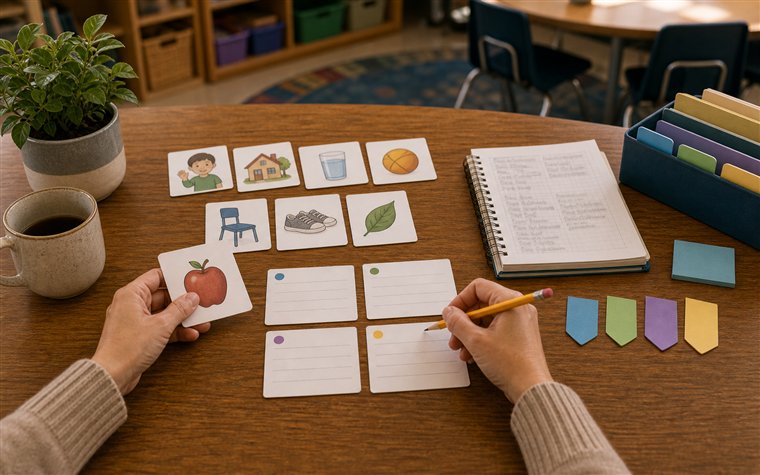
"During science sorting, matched all four animal cards to habitat pictures, pointed to the pond card when asked where the frog lives, and used the sentence frame after partner model."
That note shows content understanding, communication mode, and support. It is much stronger than "knows habitats but limited English." The first version gives you a teaching path: keep the visual cards, provide more sentence-frame practice, and look for oral language during the next science task.
Notice supports without making them permanent
Support is information, not a weakness. A student may use pictures, gestures, home language, a partner, sentence frames, bilingual glossary entries, or teacher modeling to participate in the task. Save the support so you can decide what to keep, change, or fade.
Ask:
- Which support helped the student access the content?
- Did the student use the support independently?
- Could the student show understanding in another way?
- What language opportunity should come next?
Those questions keep the note asset-based. The aim is to understand how the student is making meaning and how instruction can create the next language opportunity, not to document what the student cannot do in English.
Look for growth in participation routines
Language growth often appears in repeated classroom routines before it appears in polished writing. A student may begin by pointing, then use a word, then use a phrase, then use a sentence frame, then explain without the frame. Those steps are worth saving.
In Dodl Notes, several short notes across the same routine can show progress. For example, notes from partner talk, picture sorting, read-aloud response, and science explanation may reveal that the student is using more precise language in familiar routines. That evidence is useful for planning and for family communication because it shows participation in real instruction.
Avoid comparing students to each other in the note
Language observation notes should describe the student's current evidence, not rank the student against classmates. "Behind the group" or "less verbal than peers" does not show what the student can do or what support helped. It also risks hiding content understanding behind a comparison.
Write the note against the classroom task:
"Used the labeled diagram to explain two parts orally after partner rehearsal."
That note gives a starting point for instruction. It tells you the student used a visual, rehearsed with a partner, and produced oral language connected to content. If the next note shows the student explaining with less partner support, the growth is visible. The comparison is unnecessary.
This approach also helps when families or specialists read the evidence. They can see the classroom task, the language behavior, and the support, instead of interpreting a vague ranking.