
A work sample still needs context
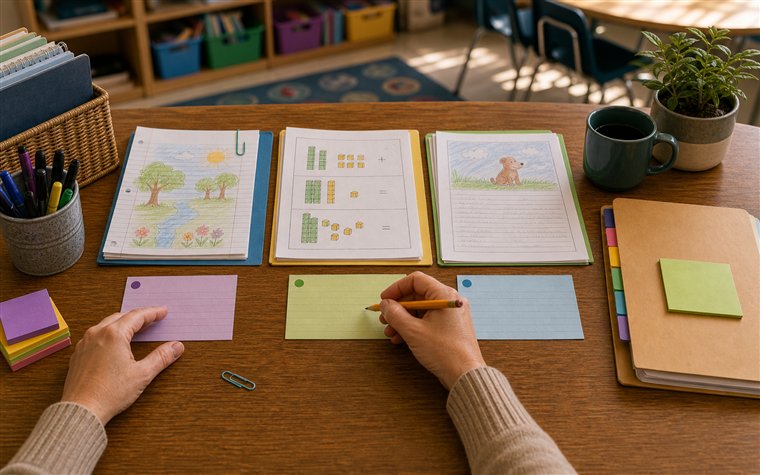
A student work sample can show what was produced, but it may not show the support, strategy, or classroom condition that made the work possible. That is where the anecdotal note matters.
The WWC data-use guide frames evidence as useful when it helps educators make decisions. A work sample plus a note can support a stronger decision than either one alone.
Save the context:
- Task.
- Student action.
- Support or independence.
- Why this sample matters.
- Next step.
That makes the sample usable before reports, conferences, or instructional planning.
Explain what the sample shows
Do not rely on the artifact to speak for itself. A math page may show correct answers but not the representation used. A writing draft may show a strong paragraph but not the feedback that shaped revision. A reading response may show comprehension but not whether the student found evidence independently.
The WWC elementary writing guide emphasizes the writing process. When saving a writing sample, note where the student was in that process:
- Planned independently.
- Added detail after feedback.
- Revised after rereading.
- Edited with a checklist.
The note helps the sample show growth rather than only final product.
Keep the observation objective
Head Start guidance on objective observation notes applies here too. Write what happened before adding meaning.
Thin note: "Good work sample."
Better note: "After using the word bank, added two content words to the science label and explained both to a partner."
Now the work sample has context. It shows language use, support, and explanation.
Use work samples for informal assessment
Reading Rockets describes informal classroom-based assessment as classroom evidence that helps identify strengths and needs. Work samples are part of that evidence, but they are stronger when connected to a teacher observation.
Ask:
- What does this sample show that I might forget?
- What support was available?
- Was the work independent, guided, partnered, or revised?
- What should I check next?
In Dodl Notes, save the note to the student history. If the work sample lives elsewhere, the note can still preserve why you saved it.
Review samples and notes together
Before report-card week, choose one work sample and one note per student if possible. The sample gives the artifact. The note gives the story.
That pairing helps you write comments that are specific and fair:
"During independent writing, she added two details after rereading her first sentence. Her final draft shows a clearer sequence than last month."
The work sample shows the product. The note explains the classroom move behind it.
Name why the sample was saved
Teachers collect many papers, photos, drafts, and quick checks. If the reason for saving the sample is not written down, the sample can become clutter instead of evidence. Add a short reason while the classroom context is still fresh.
Useful reasons include:
- Shows first independent use of a strategy.
- Shows growth after feedback.
- Shows current misconception.
- Shows transfer from small group to independent work.
- Shows communication with a partner.
- Shows a strength worth sharing with family.
The reason does not need to be fancy. "Saved because it shows independent use of the number line" is enough. Later, that phrase tells you why the artifact mattered.
Use a simple review routine
Work samples and anecdotal notes become more useful when they are reviewed together on a schedule. A monthly review can be enough for many classrooms. Choose a small number of students, open their notes, and check whether the samples still represent current learning.
Ask:
- Is this sample still current?
- Does the note explain the support level?
- Do I have both strengths and next steps?
- Is there a better recent sample?
- What should I collect next?
This prevents old samples from carrying too much weight. It also helps teachers notice gaps. A student may have several writing samples but no math context. Another may have behavior notes but no work sample that shows academic strength. The review routine turns collected artifacts into a usable evidence set.
Connect the sample to the next instructional move
The best work-sample note points forward. If the sample shows a misconception, the next step might be a model, a reteach group, or another check. If it shows growth, the next step might be transfer, independence, or a more complex task.
In Dodl Notes, the work sample note can live in the student history with conference notes, observation notes, and report-prep notes. That keeps the artifact from becoming separate from instruction. The sample shows what the student produced; the note helps you decide what to do next.
Keep the evidence manageable
You do not need to save every paper, and too many samples can make review harder. Choose artifacts that show a meaningful moment: a new strategy, a persistent misconception, a strong explanation, a revision move, or a change in independence.
When deciding whether to keep a sample, ask:
- Would this help me teach tomorrow?
- Would this help me explain growth to a family?
- Would this help me write a report comment?
- Would this help me remember the support level?
If the answer is no, the sample may not need a note. If the answer is yes, save the note while the context is fresh. A smaller set of well-explained samples is more useful than a large folder of artifacts with no story attached.
This is where anecdotal notes make the evidence lighter, not heavier. The note gives the sample a purpose, so later review takes less time.
Sources
- What Works Clearinghouse: Using Student Achievement Data to Support Instructional Decision Making
- What Works Clearinghouse: Teaching Elementary School Students to Be Effective Writers
- Reading Rockets: Basics, Informal Classroom-Based Assessment
- Head Start: Writing Objective and Accurate Observation Notes