
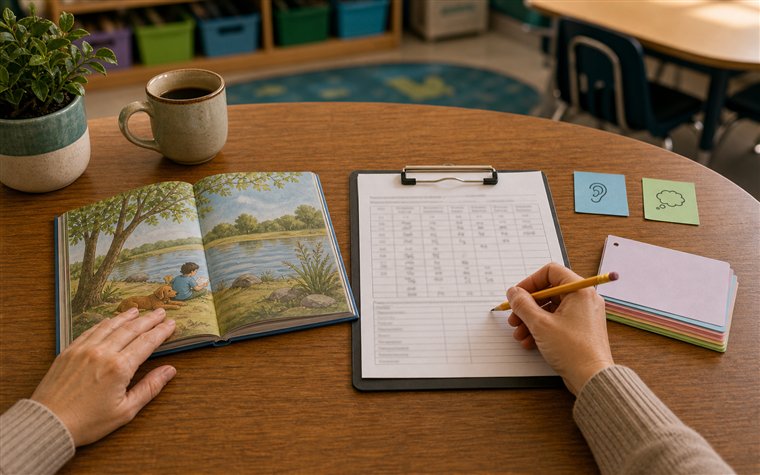
Start with the reading move
A reading conference note should preserve the student's actual reading move. "Needs fluency" may be true, but it does not tell you what the student did. "Reread the sentence after a miscued word and checked the beginning sound" gives you evidence you can teach from.
The What Works Clearinghouse reading comprehension guide emphasizes teaching students to use comprehension strategies and discuss text meaning. A conference note should make those strategies visible. If the student predicts, summarizes, asks a question, rereads, checks a word part, or explains evidence from the text, save that move.
Use a simple note shape:
- Text or task.
- Reading move.
- Prompt or support.
- Next check.
That shape keeps the note short enough for a school day and specific enough for later review.
Keep decoding and comprehension separate when needed
Reading conferences often mix many signals. A student may decode accurately but struggle to explain the text. Another may understand the story when it is read aloud but need support with word reading. If the note blends everything into one sentence, planning gets harder.
The WWC foundational reading guide separates foundational skills such as phonological awareness, phonics, fluency, and word reading. Your notes do not need research labels, but they should keep the evidence clear.
Try this:
"In the decodable text, Cam read short vowel words accurately, paused at two consonant blends, and used the picture only after I asked what would make sense."
That note shows word reading, support, and meaning-making without turning the student into a label.
Save one next check
A reading conference note becomes more useful when it names what to look for next. Do not write a full plan during the conference. Add one next check:
- Check whether rereading happens without a prompt.
- Listen for phrasing after repeated reading.
- Ask for text evidence after the first answer.
- Watch whether the same word pattern appears in writing.
Reading Rockets describes informal classroom-based assessment as everyday evidence that helps teachers identify strengths and needs. A next check turns the note into a small assessment plan.
In Dodl Notes, the next check can live with the student history. Before the next reading group, reopen the thread and watch for the specific move.
Keep the observation objective
Reading notes can drift into fixed statements quickly: reluctant reader, careless decoder, low comprehension. Those labels do not help the next lesson.
Head Start guidance on objective observation notes is a useful check: record what was seen and heard before adding interpretation. For reading, that means naming the text behavior first.
Thin note: "Mark guessed words."
Better note: "Mark said the first sound, looked at the picture, and read a word that fit the picture but not the letters."
The better note gives you a teaching path. You might work on cross-checking meaning with letters. You might choose a text with a known pattern. The note points to instruction.
Review reading notes before groups are planned
Once a week, open a few reading histories and look for patterns. Which students have notes about decoding only? Which have comprehension notes but no fluency evidence? Which notes include a next check that never happened?
Reading conference notes should make planning lighter. If the note helps you choose tomorrow's prompt, group focus, or report example, it is doing its job.
Use one note to protect the next conference
The next reading conference goes better when the previous note names one thing to check. Without that target, each conference can feel like a fresh start. That wastes the evidence you already collected.
Before the next group, reopen the student history and choose a focus:
- Check the same decoding pattern in a new text.
- Ask for the same comprehension strategy without a model.
- Listen for phrasing after repeated reading.
- Bring back the same vocabulary word in discussion.
- Compare the student's first answer with the evidence they used.
This review does not need to take long. The point is to turn a saved note into a teaching move. If the student used rereading only after a prompt last time, you know what independence might look like this time. If the student explained the main idea orally but not in writing, you know which response format to watch.
Reading conference notes also help when evidence feels uneven. One student may have several decoding notes and no comprehension examples. Another may have broad participation notes but no current text evidence. The weekly review tells you what to observe next.
Keep the routine small: save the move, save the prompt, save the next check. That is enough to make reading conferences build on each other instead of floating as separate conversations.
Make the note useful beyond the reading table
The same conference note may later support a specialist conversation, a family conference, or a report-card comment. It does not need formal language; it just needs to be understandable after the conference has passed.
Before saving, check whether someone else could answer three questions from the note:
- What text or task was the student working with?
- What reading behavior was visible?
- What support or next check did the teacher choose?
If the note answers those questions, it can travel farther. You can still polish the language later, but the evidence will already be there. This is especially helpful for first-year teachers, who often remember the feeling of a conference but not the exact reading move once several groups have happened.