
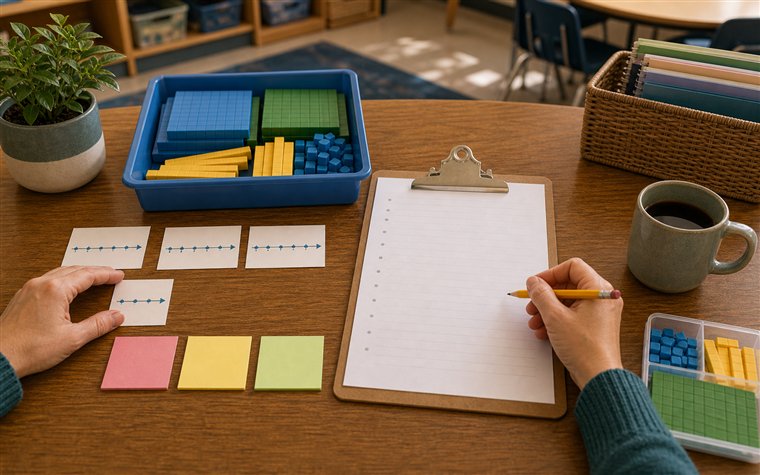
Start with the representation
A useful math observation note usually names the representation before the interpretation. Did the student use counters, a number line, a drawing, an equation, base-ten blocks, a table, mental math, or a known fact? That detail helps you see whether the student understands the concept or is relying on a temporary support.
The WWC math intervention guide emphasizes explicit instruction, visual representations, and focused practice for students who struggle in math. Classroom notes can support the same work by recording which representation helped and where the student still got stuck.
Thin note: "Needs help with subtraction."
Better note: "Used base-ten blocks to show 42 minus 18, traded one ten for ones after a prompt, then wrote 34 instead of 24."
The better note shows the support, action, and error pattern.
Capture the error pattern without overgeneralizing
Math mistakes can look random until several notes sit together. One student may reverse digits, skip a step, count all instead of counting on, or apply a rule from one problem type to another. The note should describe the pattern without turning one mistake into a fixed weakness.
The WWC guide on assisting students struggling with mathematics highlights systematic instruction and clear models for students who need support. A good note helps you choose the model to revisit.
Use this shape:
- Problem type.
- Representation used.
- Student action.
- Error or strategy.
- Next model to try.
That gives you enough information for the next lesson without writing a full analysis during class.
Link the note to the next teaching move
Math observation notes should not stop at what went wrong. Add one next teaching move:
- Model regrouping with base-ten blocks again.
- Ask the student to explain the equation after drawing.
- Check whether the number line helps with elapsed time.
- Compare two strategies side by side.
- Watch whether the same error appears in independent work.
The WWC data-use guide recommends using evidence to ask focused questions and plan action. A math note is useful when it helps you decide what to try next.
In Dodl Notes, save the note to the student history and reopen it before the next small group. The note should be close enough to instruction that it changes what you do.
Keep the observation objective
"Doesn't understand fractions" may describe your concern, but it is too broad for a note. Write what happened:
"Matched one-half to two shaded parts out of four, then changed the answer after comparing the pieces."
Head Start guidance on objective observation notes gives a useful rule: record what you see and hear before adding interpretation. In math, objective notes protect students from being reduced to one misconception.
Review across the week
At the end of the week, scan math notes for the class or small group:
- Which representation helped most?
- Which error pattern repeated?
- Who needs another concrete model?
- Who is ready to explain the strategy without materials?
Math observation notes do not need to be long. They need to preserve the strategy, the representation, and the next instructional question.
Watch for transfer beyond the small group
A math strategy may look secure in small group and disappear during independent work. The small-group note was not wrong; it just needs to help you check transfer.
After saving a math observation, add one place to look next:
- Same skill in independent practice.
- Same representation with a different number set.
- Same strategy during partner explanation.
- Same error pattern in a word problem.
- Same support with less teacher prompting.
This matters because progress is not only correct answers during supported practice. A student may solve with base-ten blocks but not connect the blocks to an equation. Another may explain a number line strategy orally but write a different operation. A third may use the strategy in small group but return to counting all during independent work.
Save that transfer evidence in the same student history. In Dodl Notes, the first note can name the supported strategy, and the next note can show whether the student used it with less support. That sequence is much easier to interpret than a single score.
If the strategy does not transfer, the note gives you options. You might keep the representation, reduce the problem type, model the language for explaining the strategy, or check whether vocabulary is blocking the math. The note helps you choose the next instructional adjustment instead of guessing from memory.
Keep math strengths visible too
Math notes should not only capture errors. Save strengths that could guide future teaching:
- Chose an efficient strategy.
- Explained a representation clearly.
- Checked the answer with a different method.
- Helped a partner correct a misconception.
- Used math vocabulary accurately after a model.
Those strengths are useful for grouping, conferences, and report comments. They also keep the student history balanced.
Use correct answers as evidence, not the whole story
A correct answer can still hide important information. The student may have guessed, copied a model, counted every object, or used a strategy that will not scale to larger numbers. The note should capture the route to the answer when the route matters.
For example:
"Solved 36 plus 27 correctly with base-ten blocks, then explained the trade from ten ones to one ten after I asked what changed."
That note is stronger than "correct with support" because it shows both accuracy and understanding. It helps you decide whether to keep the representation, ask for a drawing next time, or move toward the equation. Math notes should help explain how the answer happened.
Sources
- What Works Clearinghouse: Assisting Students Struggling with Mathematics
- What Works Clearinghouse: Assisting Students Struggling with Mathematics, Intervention Guide
- What Works Clearinghouse: Using Student Achievement Data to Support Instructional Decision Making
- Head Start: Writing Objective and Accurate Observation Notes